Industry · Food manufacturing · 2017–2026
PT Takara Indonesia: measuring reliability across nine years of operation.
A documented journey from initial design and routine care to component renewal, media replacement, water-quality verification, and total cost of ownership.
 Smart Solutions for Reliable Water.
The operating need
Water treatment that supports continuity in food manufacturing.
PT Takara Indonesia manufactures food ingredients for Japanese noodles. Water supports production and hygiene, so the solution was evaluated through its ability to maintain quality, flow, serviceability, and continuity—not purchase price alone.
System scope
Three functions, designed as one water pathway.
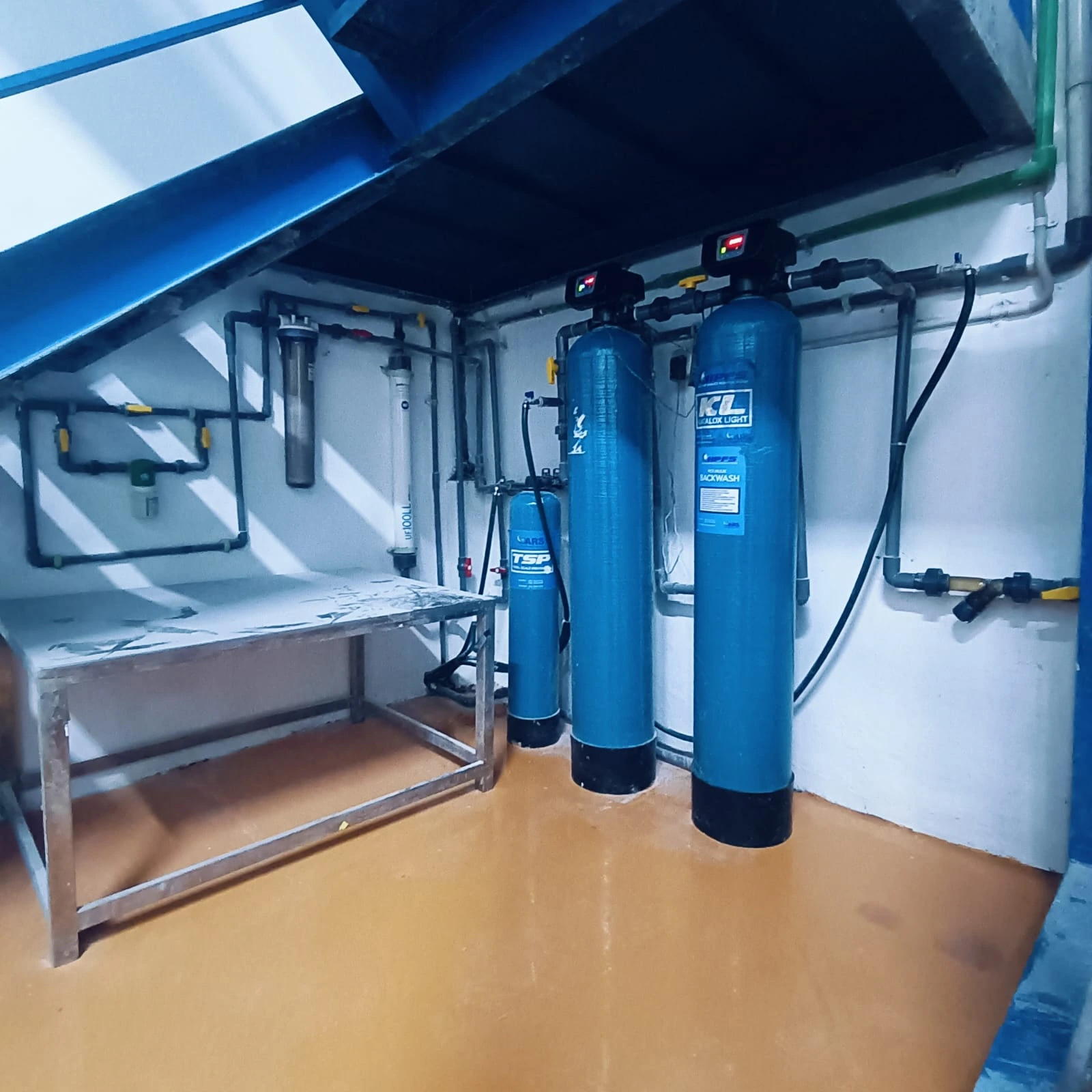
The recorded configuration combines risk removal, scale control, and point-of-process drinking-water treatment. Each stage has a distinct purpose.
ARS HPFS KL–CC 1000 LPH
Pretreatment for suspended material, iron, manganese, colour, odour, and other source-water risks relevant to the design.
ARS TSP Anti-Scaling 1000 LPH
Scale-risk management to help protect the water pathway and downstream equipment.
SafeDrink UF10 Manual 1000 LPH
Ultrafiltration for the drinking-water process, operated and maintained as a separate functional barrier.
Lifecycle record
What happened between 2017 and 2026.
- Sep 2017
Initial installation
HPFS KL–CC, TSP Anti-Scaling, and SafeDrink UF10, each at 1000 LPH.
- 2018–2023
Routine care
HPFS regeneration, UF cleaning, testing, and selected component work were recorded.
- Apr 2024
SafeDrink renewal
The SafeDrink UF10 module was replaced after approximately 6 years and 7 months of use.
- 2024–2025
Monitoring continued
HPFS regeneration, water-quality checks, and supporting service continued.
- Aug 2026
Media replacement and verification
Katalox Light media was replaced after nearly nine years, followed by independent laboratory testing.
The available service and transaction history contains no recorded production downtime attributed to this water-treatment system. This statement reflects the records reviewed; it is not an independently audited availability calculation.
Documented TCO
The full cost record gives context to the initial investment.
The summary covers the documented system from September 2017 to August 2026. Amounts are rounded for presentation and should not be read as a quotation for another site.
Independent laboratory verification
Physical, chemical, and microbiological results from August 2026.
Independent laboratory reports 138/Lab-Eks/VIII/2026 and 139/Lab-Eks/VIII/2026 were issued by the laboratory of Perumda Air Minum Tirta Kerta Raharja, Tangerang Regency. Samples were collected on 24 August 2026.
| Parameter | Unit | Result | Report standard |
|---|---|---|---|
| Odour | — | Not detected | Not detected |
| Turbidity | NTU | 0.18 | <3 |
| Colour | TCU | <5 | 10 |
| TDS | mg/L | 70.6 | <300 |
| pH | — | 7.58 | 6.5–8.5 |
| Nitrate (as NO₃⁻) | mg/L | 4.6 | 20 |
| Nitrite (as NO₂⁻) | mg/L | 0.043 | 3 |
| Dissolved iron | mg/L | <0.05 | 0.2 |
| Dissolved manganese | mg/L | <0.037 | 0.1 |
| E. coli | colony/100 mL | 0 | 0 |
| Total coliform | colony/100 mL | 0 | 0 |
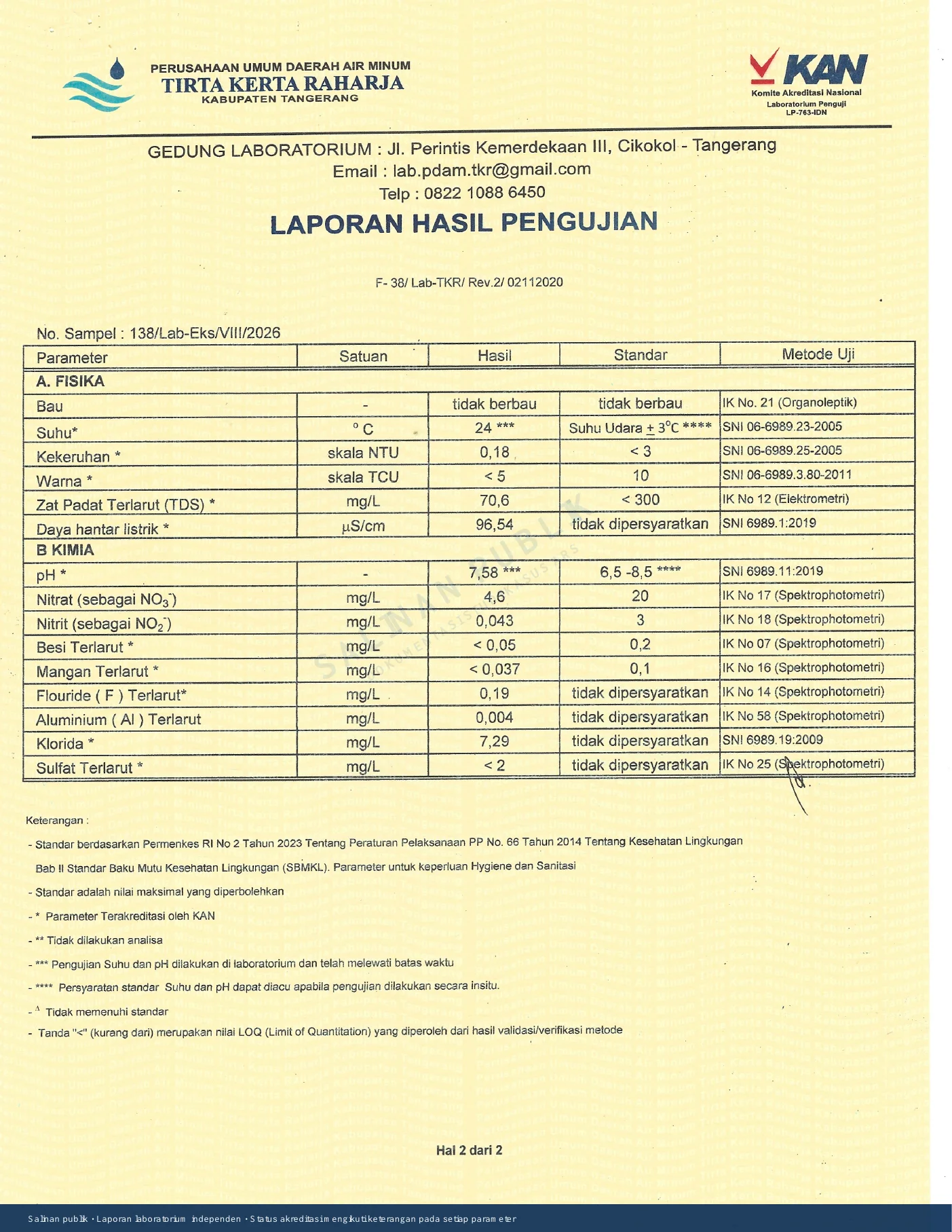
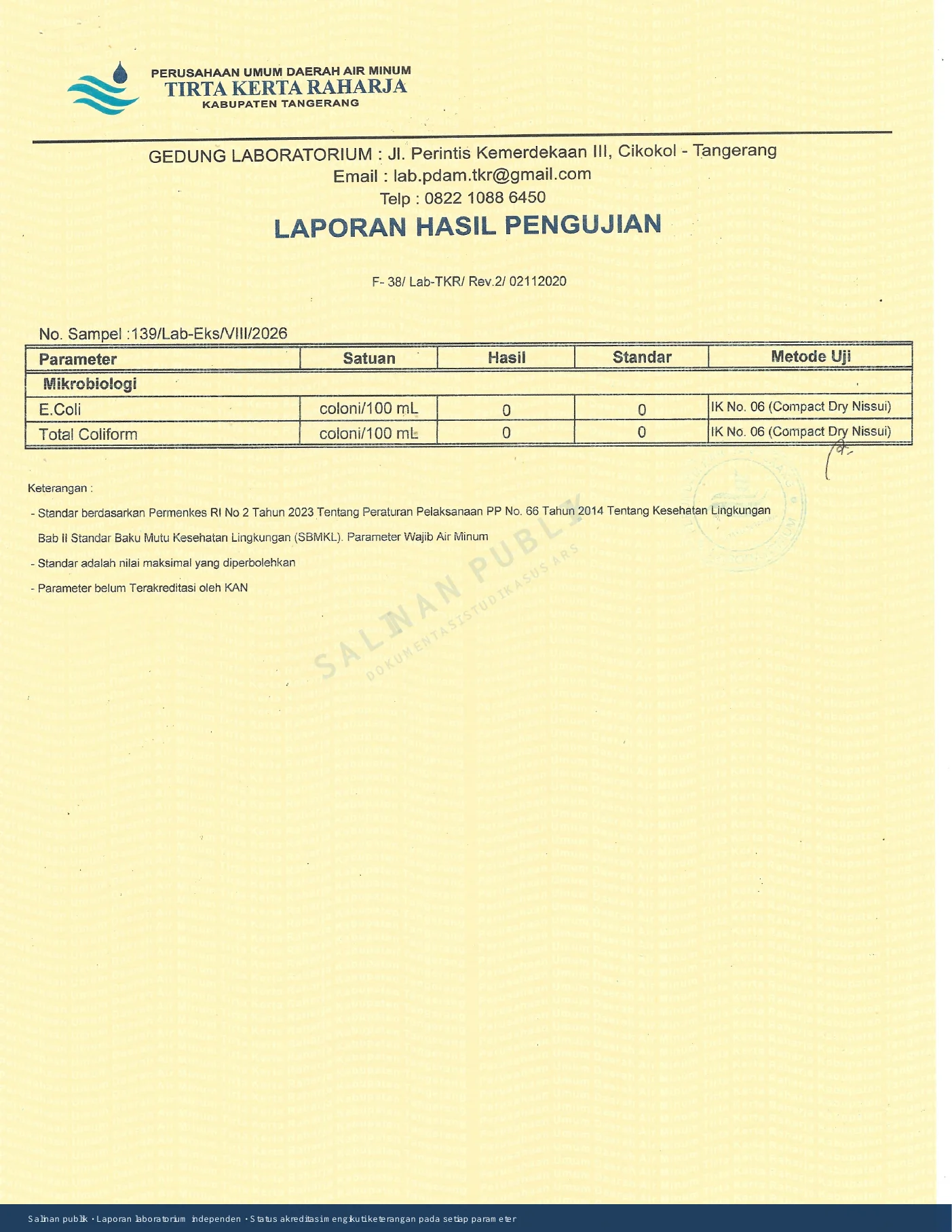
Scope note: the laboratory displays KAN accreditation LP-763-IDN. The report states that parameters marked with an asterisk are accredited by KAN; the microbiological report states that its listed parameters were not yet accredited by KAN. Results apply only to the submitted samples, parameters, and dates. The standards shown are those printed in the reports.
The practical lesson
Reliability is built through a lifecycle, not delivered by one installation day.
The Takara record shows how design, scheduled care, component renewal, testing, and cost records can be read together. It does not prove that every system will achieve the same life or cost; source water, operating load, maintenance, and site conditions remain decisive.
Discuss your system lifecycle