ARS Drinking-Water Businesses

Two business models. One discipline for drinking-water quality.

The NanoWater-Q Refill Drinking-Water Depot is the primary focus. For hotels, institutions, and businesses, the ARS In-House Bottling Plant System enables on-site drinking-water treatment and filling with a returnable-glass-bottle option.

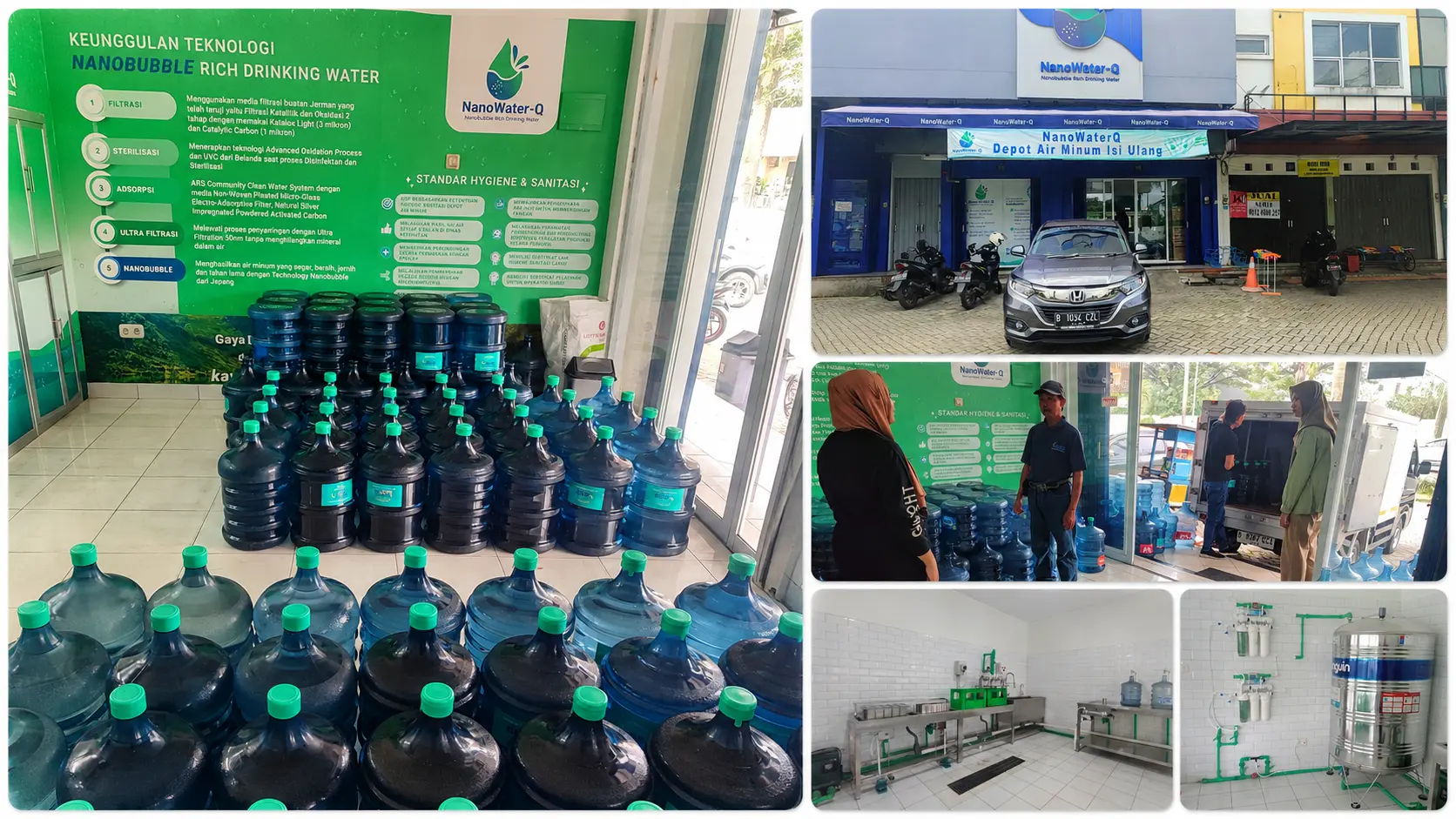
Collage of NanoWater-Q depot operations and the ARS In-House Bottling Plant System installed at P4TKNanoWater-Q Depot · In-House Bottling Plant

Two drinking-water business models

One process discipline. Two service models.

NanoWater-Q refill depots are the primary model. ARS also designs in-house bottling systems for hotels, institutions, and businesses that want to manage their own drinking-water supply.

01 · Primary focus

NanoWater-Q Refill Drinking-Water Depot

A refill-gallon business designed to serve households, communities, and local institutions. ARS brings together source-water assessment, treatment, sanitation, operating procedures, quality monitoring, customer service, and operational support.

Refill gallons · local service · repeatable operations
02 · On-site production

ARS In-House Bottling Plant System

An on-site drinking-water treatment and filling system for hotels, institutions, and businesses. A returnable-glass-bottle model can reduce reliance on single-use plastic bottles while keeping production under the organisation's own operational control.

Returnable glass · internal supply · controlled filling

Drinking-water quality depends on source-water conditions, process design, sanitation, operating controls, applicable permits, and regular laboratory verification. Each installation must be assessed and validated individually.

Inside the depot

The technology behind NanoWater-Q.

See how five treatment stages are integrated into a closed process designed to reduce open handling and minimise exposure before filling.

100-second AOP sterilisation overviewOriginal Indonesian narration · UVC, ozone, hydroxyl radicals, and closed-loop circulationFor the complete video and a more detailed explanation of the NanoWater-Q Depot, contact the ARS office.
Integrated closed process

From treatment to storage with less open handling.

Closed pipework and integrated process vessels are designed to minimise environmental exposure and the risk of recontamination before filling.

  1. 01

    Filtration

    Initial treatment is configured around the source-water condition and the parameters that need to be addressed.

  2. 02

    Sterilization

    A controlled disinfection stage forms part of the multi-barrier treatment process.

  3. 03

    Adsorption

    Selected media help address relevant dissolved compounds, odour, taste, and organic loading.

  4. 04

    Ultrafiltration

    A fine membrane barrier adds physical protection before the functional-water stage.

  5. 05

    Nanobubble

    The final technology stage produces NanoWater-Q as nanobubble-rich drinking water.

The video demonstrates the physical configuration and process flow. Finished-water safety is verified through water-quality testing, sanitation procedures, and operating controls.

Risks to address

Conditions that should not become business as usual.

For prospective depot operators, cooperatives, village-owned enterprises, communities, schools, hotels, offices, institutions, businesses, partners, and investors.

01

Drinking-water access that is not yet practical

02

Dependence on external supply

03

Business units without SOPs or monitoring

04

Technology without operating capability

05

Dependence on single-use plastic bottles

06

Expansion without a pilot or site feasibility study

The ARS approach

Choose the business model. Establish feasibility and quality control.

ARS starts with demand, source-water quality, site feasibility, target market, service model, system design, sanitation, SOPs, quality verification, and a pilot before investment or expansion decisions are made.

Every location requires its own study, permits, contract, testing, and feasibility assessment. Expansion potential does not guarantee investment results.
01

Feasibility

Water source, demand, location, permits, competition, and target volume are assessed first.

02

Business model

Refill depot or in-house bottling is selected according to users, service pattern, volume, and operating capability.

03

Water & filling system

Treatment, storage, filling, and sanitation are configured around the source water and quality target.

04

Operate, verify, scale

SOPs, records, service, quality control, and laboratory verification are prepared before replication.

Intended value

More than water flowing from a tap.

A model suited to the market and operation

More data-based investment decisions

Technology and operations designed together

More structured quality monitoring

Potential to reduce single-use plastic bottles

Potential for repeatable business development

Understand the principles

Related ARS Water Insights

01Clear water is not always safe02Filtration and disinfection are not the same03TDS is not the only measure of water quality

Start with clarity

Data → survey → design → implementation.

The first requirements are access to relevant data, a responsible contact person, and an opportunity to understand site conditions.

Discuss your requirements
Chat with ARS