See the whole cost, not only the purchase price
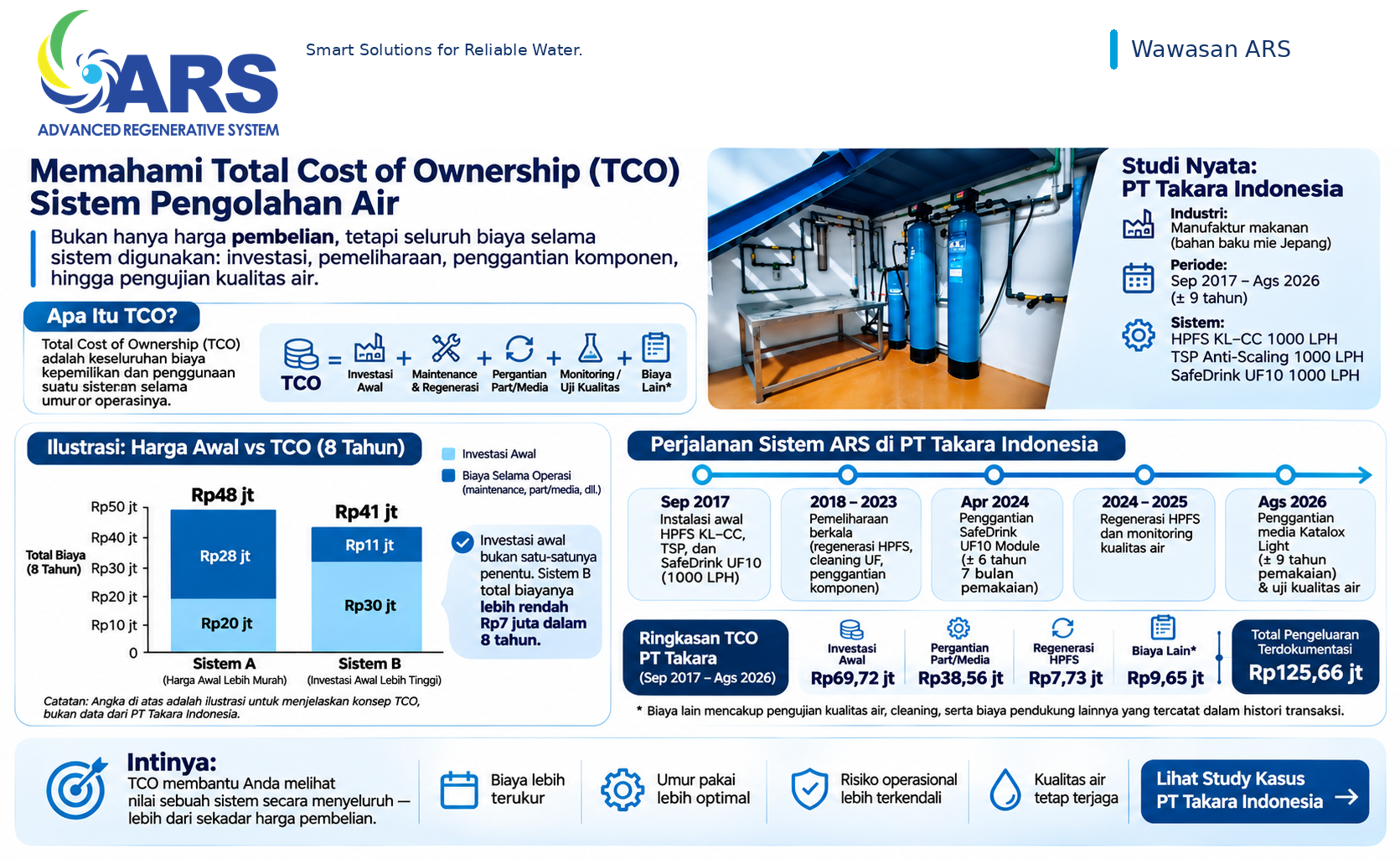
The infographic combines the TCO framework with the documented 2017–2026 journey of the ARS system at PT Takara Indonesia.
Purchase price is one part of the decision
Two systems can begin at different prices while their operating costs move in the opposite direction. A lower-cost unit may use more energy, reject water, chemicals, media, membranes, labour, or replacement parts. A higher initial investment may offer good value when it operates steadily, is practical to maintain, and avoids costly disruption.
Total Cost of Ownership, or TCO, places the initial price inside the full cost of owning and using the system over a defined assessment period.
What belongs in TCO?
TCO can include assessment and design, procurement and installation, energy, wasted water, chemicals, regeneration, consumables, media and membranes, spare parts, operating labour, inspection, sanitation, laboratory testing, scheduled service, and end-of-life costs. The boundary must be explicit.
The consequences of unavailability may also matter. Downtime can interrupt production or service, create rework, or require emergency supply. Its value is specific to each operation and should not be generalised without data.
Compare systems on the same basis
A TCO comparison is meaningful only when flow, operating hours, source-water quality, output target, redundancy, and assessment period are equivalent. A simple unit cannot be compared directly with a system that also includes pretreatment, scale protection, drinking-water treatment, monitoring, and service.
State assumptions for inflation, energy and water tariffs, replacement schedules, labour, and residual value. Where uncertainty matters, show scenarios rather than presenting one number as certain.
Reliability and water quality are part of value
TCO is more than adding invoices. A water system has a job: deliver the required quality, flow, pressure, and continuity. A low cost is not efficient if quality repeatedly misses target or capacity is inadequate.
Useful evidence can include water-test results, pressure and flow, energy use, regeneration or cleaning frequency, component changes, interruptions, and service response. These data connect expenditure to the result received by the user.
A lesson from PT Takara Indonesia
ARS service and transaction records for PT Takara Indonesia cover the journey from initial installation in September 2017 to Katalox Light media replacement and water testing in August 2026. The system includes HPFS KL–CC 1000 LPH, TSP Anti-Scaling 1000 LPH, and SafeDrink UF10 1000 LPH.
For the documented system, the September 2017–August 2026 TCO summary is approximately IDR125.66 million: about IDR69.72 million initial investment, IDR38.56 million component replacement, IDR7.73 million HPFS regeneration, and IDR9.65 million testing, cleaning, and other recorded support costs. This is one site and configuration, not a cost promise for another project.
Use TCO to make a responsible decision
Begin with the water problem and intended use, not an equipment list. Set quality and capacity targets, map the risks, and ask every proposal to state operating assumptions, care intervals, expected replacements, verification, and service support.
TCO will not always select the same technology. It shows the consequences of each option so that the technical, operating, and financial decision can be defended across the system's life.
Checklist before comparing proposals
- ✓Are source water, test data, flow, operating hours, and quality targets the same?
- ✓Are the TCO period and system boundary defined?
- ✓Are energy, reject water, chemicals, consumables, media, membranes, and spare parts included?
- ✓Are labour, inspection, sanitation, testing, and service included?
- ✓How are downtime and emergency supply evaluated?
- ✓Which indicators will verify quality and performance after installation?
- ✓Are assumptions and uncertainty shown openly?
The ARS perspective
ARS evaluates solutions through Water Source × Use × Risk × Lifecycle. TCO connects design to operating reality: cost, performance, verification, and care are treated as one system. The aim is a fit-for-purpose solution that is measurable, maintainable, and reliable throughout use.
Official references
This material provides general education. It does not replace laboratory testing, applicable local requirements, or a professional assessment of a specific water system.